
Start with the business case. Then design the organisation.
A discussion about a new team, investment or initiative often begins with an answer: hire this person, create this role, buy this platform. The business then works backwards to justify a preferred solution. The more attached we become to that solution, the harder it is to see an alternative.
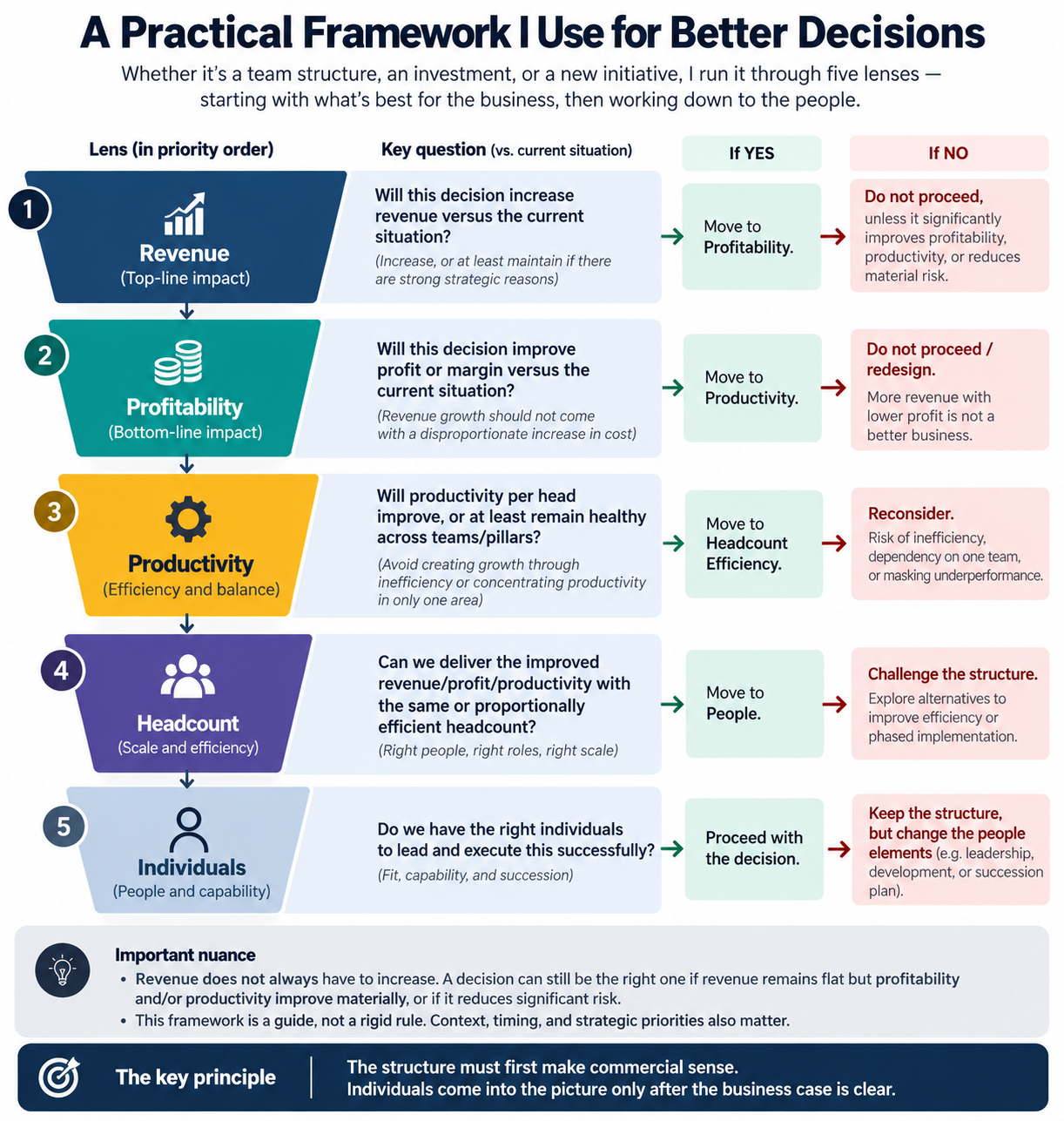
I use five lenses to slow that reflex: revenue, profitability, productivity, headcount efficiency and individuals. The order forces a commercial argument before the conversation settles on names, reporting lines or familiar ways of working.
This is an order for examining a proposal, not a ranking of human worth. People, ethical obligations, safety and legal requirements remain constraints throughout. A financially attractive option that breaches those boundaries is not made acceptable by passing five questions.
The structure must first make commercial sense. Then ask what capability will make it work.
Work through the five lenses.
Choose an illustrative scenario or start with a blank assessment. Answer each question relative to the current situation. The framework identifies the first unresolved issue, so a strong answer later in the sequence cannot silently cancel an earlier weakness.
There is one explicit exception at the revenue lens: flat or lower revenue can be acceptable where a material profitability or productivity improvement, or a significant risk reduction, justifies it. Make that rationale visible. An unknown answer is a request for evidence, not a disguised yes.
Lenses 1 and 2: distinguish growth from value.
Revenue: Will the decision increase revenue relative to the current situation—or at least maintain it where there is a strong strategic reason? Name the mechanism. More capacity creates revenue only if demand, conversion and delivery can turn that capacity into paid work.
This lens is not a command to maximise sales at any cost. Exiting an unattractive customer segment may reduce revenue while improving the business. A resilience investment may preserve a business that would otherwise face a material risk. Such cases need an explicit exception and a defensible counterfactual.
Profitability: Will profit or margin improve after the costs needed to deliver the decision? Separate recurring benefits from one-off implementation cost. Include support, training, integration, management time and the cost of maintaining the solution.
A project that looks attractive only because its costs sit in another department has not become profitable; the accounting boundary has hidden part of the decision. If the immediate economics deteriorate, redesign the proposal or document a time-bound strategic case with explicit governance. Do not quietly turn a ‘no’ into a ‘yes’.
- State the baseline and the comparison period.
- Separate the base case, downside case and the assumptions responsible for the difference.
- Name the owner of each benefit and the point at which it should become observable.
Lenses 3 and 4: test the operating model.
Productivity: Will useful output per head improve, or remain healthy across the teams involved? Productivity is not simply activity per person. More calls, code or reports can coexist with weaker quality, rework and slower decisions.
Use a measure tied to the work: accepted deliveries per team, quality-adjusted revenue per consultant, time to a usable decision, or another outcome with a meaningful quality boundary. Look across the whole process so an improvement in one team does not merely transfer work to another.
Headcount efficiency: Can the improved outcome be delivered with the same or proportionally efficient staffing? This is a design question. It asks whether roles, skills and workload fit the intended output. It is not an automatic argument for fewer people.
A specialist hire can improve the productivity of a larger team. An additional support role can release senior capacity. Equally, more headcount can conceal unclear responsibilities or a process that should have been simplified first. Compare redesign, redeployment, automation, partnership and phased implementation before treating hiring as the default.
Efficiency means a sound relationship between capacity, quality and outcomes—not the smallest possible team.
Lens 5: can the people make the design real?
Only after the business case and operating structure are credible do I ask whether the right individuals are positioned to lead and execute. That keeps loyalty to a familiar structure—or enthusiasm for a particular person—from deciding the economics in advance.
Assess the capabilities the work requires: judgement, domain knowledge, relationships, execution discipline and the ability to learn. Make role expectations explicit and examine evidence relevant to those expectations. A title is not evidence of readiness.
If the structure is sound but the capability is incomplete, work on the people plan. That can mean coaching, development, a changed remit, a complementary appointment or succession planning. A ‘no’ at this stage is a prompt to address the gap, not an automated judgement about anyone’s employment.
The final commitment should identify accountable owners, dependencies and a review date. A good decision still needs an operating rhythm to become a good outcome.
Be precise about uncertainty, not theatrical about certainty.
A persuasive proposal can still rest on a fragile assumption. For each lens, write down what is observed, what is estimated and what must be true for the expected benefit to appear. Then ask what evidence would change your mind.
HM Treasury’s Green Book treats appraisal as a comparison of options under uncertainty and asks practitioners to account for optimism bias in costs, benefits and timing. The useful discipline here is to challenge the forecast with evidence from comparable decisions. It does not turn this five-lens framework into a financial appraisal model.
Where uncertainty is high and the choice is reversible, a small pilot may be more informative than a larger spreadsheet. Where the choice is difficult to reverse, the evidence and review requirements should be stronger. Choose the level of analysis to match the stakes.
- What happens if the expected benefit arrives later than planned?
- Which cost is most likely to be understated?
- What is the smallest experiment that would resolve the most consequential uncertainty?
- Which outcome would trigger a pause, redesign or reversal?
Leave a decision record your future self can challenge.
The framework is a guide, not a rigid rule. Some decisions begin with a non-negotiable obligation or an urgent risk. Make that context explicit instead of pretending every proposal follows an identical commercial path.
For ordinary discretionary decisions, keep a concise record: the problem, the baseline, the alternatives, the answers through all five lenses, the assumptions, the owner and the review date. Record the reasoning before the outcome is known. Otherwise, hindsight will make almost any result look inevitable.
At the review, distinguish decision quality from luck. A well-reasoned choice can encounter an adverse outcome; a weak choice can benefit from a favourable market. Update the assumptions and the method, not merely the story you tell about the result.
A better decision is one you can explain before acting, test while delivering and learn from afterward.
Sources & context
Further reading on comparing options, uncertainty and optimism bias. The five-lens sequence is Qasim MB’s practical framework, not a Treasury methodology or a validated scoring instrument.